
Your abandoned cart sequence is live. Three emails. Maybe a discount on the last one. Recovery rate still looks sad in WooCommerce analytics.
Before you rewrite every subject line, check the timing. Most stores send the first email too late, the second too soon, or all three within a window when the customer already bought somewhere else.
Cart recovery isn’t just copy — it’s when you show up.
If your emails aren’t working at all, read our breakdown on why cart recovery emails fail first. This post is about timing and channel choice once the basics work.
Why Timing Beats Clever Subject Lines
Someone adds a $120 skincare bundle to cart at 11 PM on their phone. They got distracted — kid crying, train stop, battery died. They didn’t “reject” your brand. They paused.
If your first email arrives 24 hours later with “We miss you!” energy, they’ve already:
- Bought from a competitor
- Decided they don’t need it
- Forgotten what was in the cart
The same email sent at the right moment feels helpful. Sent at the wrong moment feels like spam.
A Timing Framework That Works for Most Stores
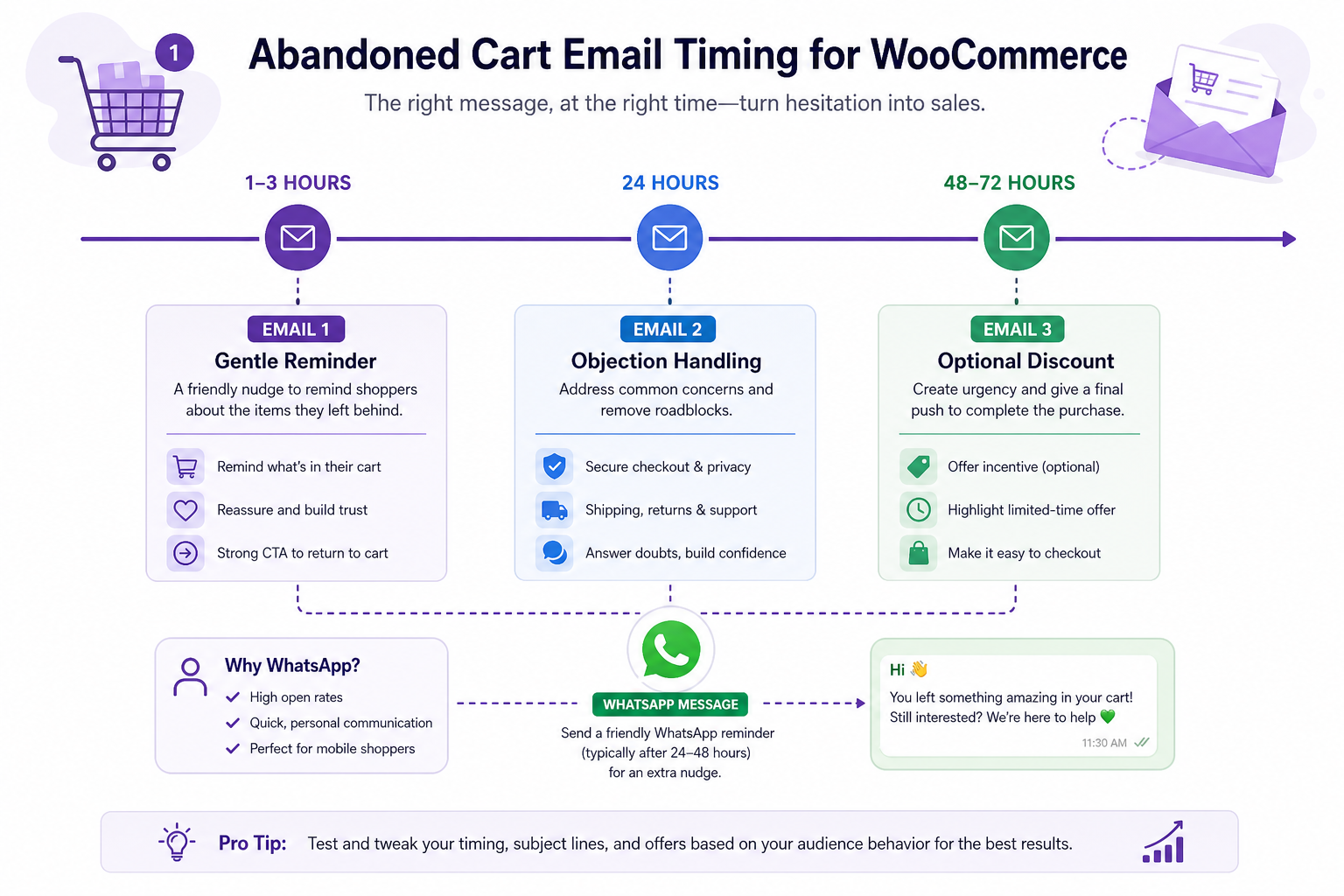
There’s no single perfect schedule — high-ticket B2B is different from impulse-buy fashion. But this starting point beats what we see on most WooCommerce stores:
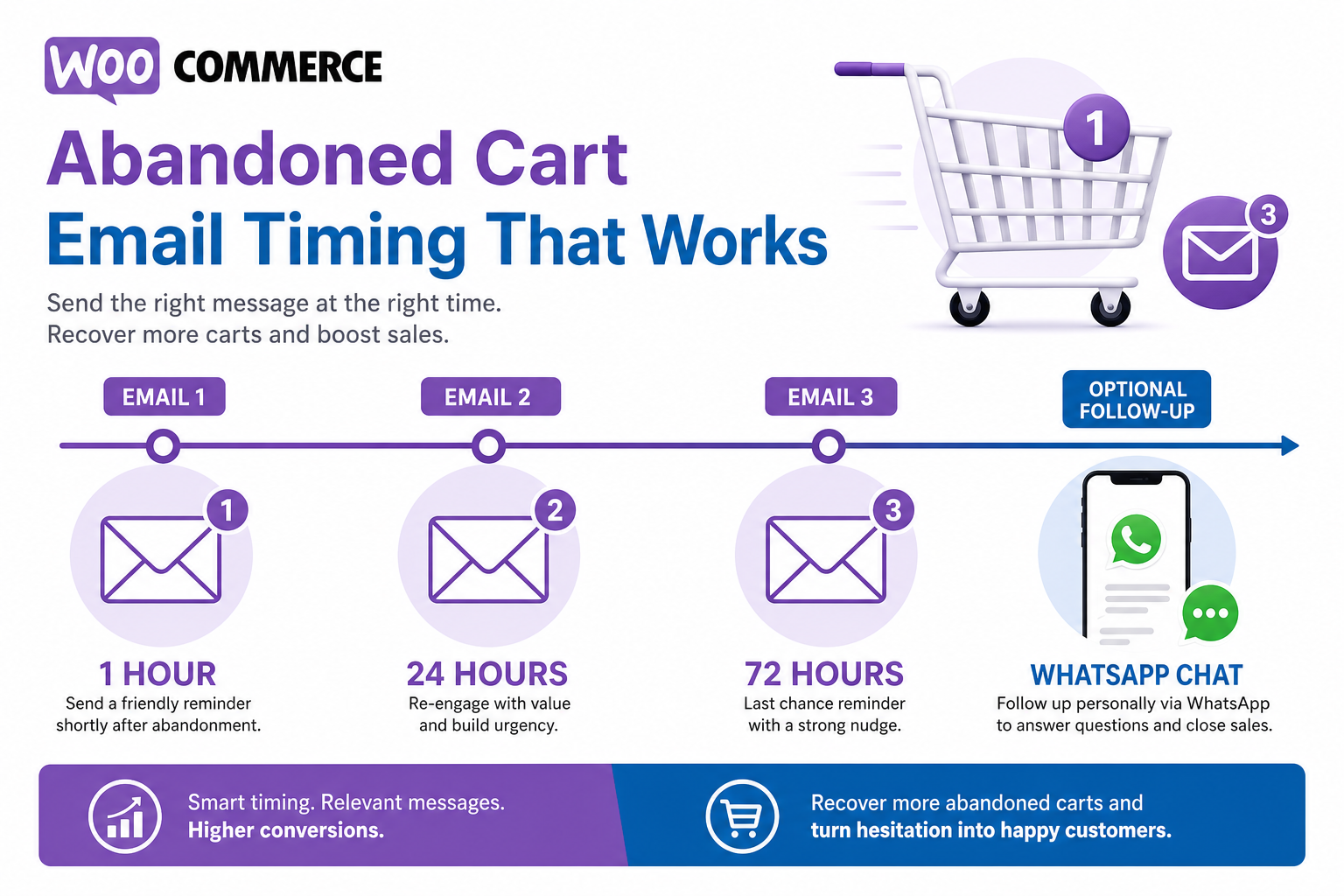
Email 1: 1–3 hours after abandonment
Not instant (that feels creepy). Not next morning (too late for many impulse carts).
Goal: remind, don’t sell hard.
- Show cart contents clearly
- One-click return to checkout
- No coupon yet unless your margins are already built for it
Email 2: 20–24 hours later
Address the real objections: shipping cost surprise, payment failure, trust, sizing.
Include social proof if you have it — review snippet, guarantee, return policy link.
Email 3: 48–72 hours later (optional)
Last nudge. If you offer a discount, do it here — not on email 1. Training customers to abandon carts for codes is a real problem.
For low-margin stores, skip the discount entirely and lead with urgency (genuine stock limits only — fake countdown timers burn trust).
Adjust for Your Product Type
Low-cost impulse buys — compress the window. First email within an hour might be fine. Third email by end of day 2.
High-ticket or considered purchases — stretch it. Someone buying a $2,000 course or custom furniture might need 5–7 days and educational follow-up, not three “complete checkout” blasts.
Subscriptions and replenables — remind them what they’re running out of, not just “you left items in cart.”
When Email Loses to WhatsApp (Or SMS)
In plenty of markets — UAE, Saudi, India, Brazil, parts of Europe — people live in WhatsApp, not inbox zero.
If open rates on email 1 are under 15% and your customers gave a phone number at checkout, a polite WhatsApp reminder can outperform a fourth email nobody opens.
Keep it short:
- First name if you have it
- What they left
- Direct checkout link
- Easy opt-out so you don’t annoy them forever
MiroCart Recovery handles email sequences plus one-click WhatsApp follow-up templates for stores that sell where chat beats email.
COD and “Almost Ordered” Customers
Cash-on-delivery stores see a different abandonment shape — people reach checkout, hesitate on COD fees or delivery timing, and drop off.
Recovery messaging should mention delivery date, COD process, and support contact — not generic “forgot something?” copy written for US credit-card checkout.
Confirmation-style WhatsApp messages after order placement reduce fake COD orders too — different problem, same channel truth.
What to Measure (So You’re Not Guessing)
Track per email in the sequence:
- Send count
- Open rate (email)
- Click rate
- Recovered revenue attributed to that step
- Unsubscribe / spam complaints
If email 1 gets clicks but no purchases, the problem might be checkout friction — not email 2’s subject line. Fix the leak before adding more emails.
Compare recovery rate week over week after timing changes. One A/B test on send delay teaches more than rewriting hooks for a month.
Common Timing Mistakes
- All emails in 12 hours — feels desperate
- First email after 48 hours — cart is cold
- Discount on email 1 — trains abandonment
- Same timing for mobile and desktop — mobile abandoners often convert faster with faster reminders
- Ignoring timezone — 8 AM sends help; 3 AM sends don’t
The takeaway
Abandoned cart recovery is a timing game first and a copywriting game second. Start with a sensible 3-step schedule, tune it for your product type, and add WhatsApp where your customers actually respond.
Then fix checkout, then fix email content. In that order — or you’re optimizing messages nobody sees.