
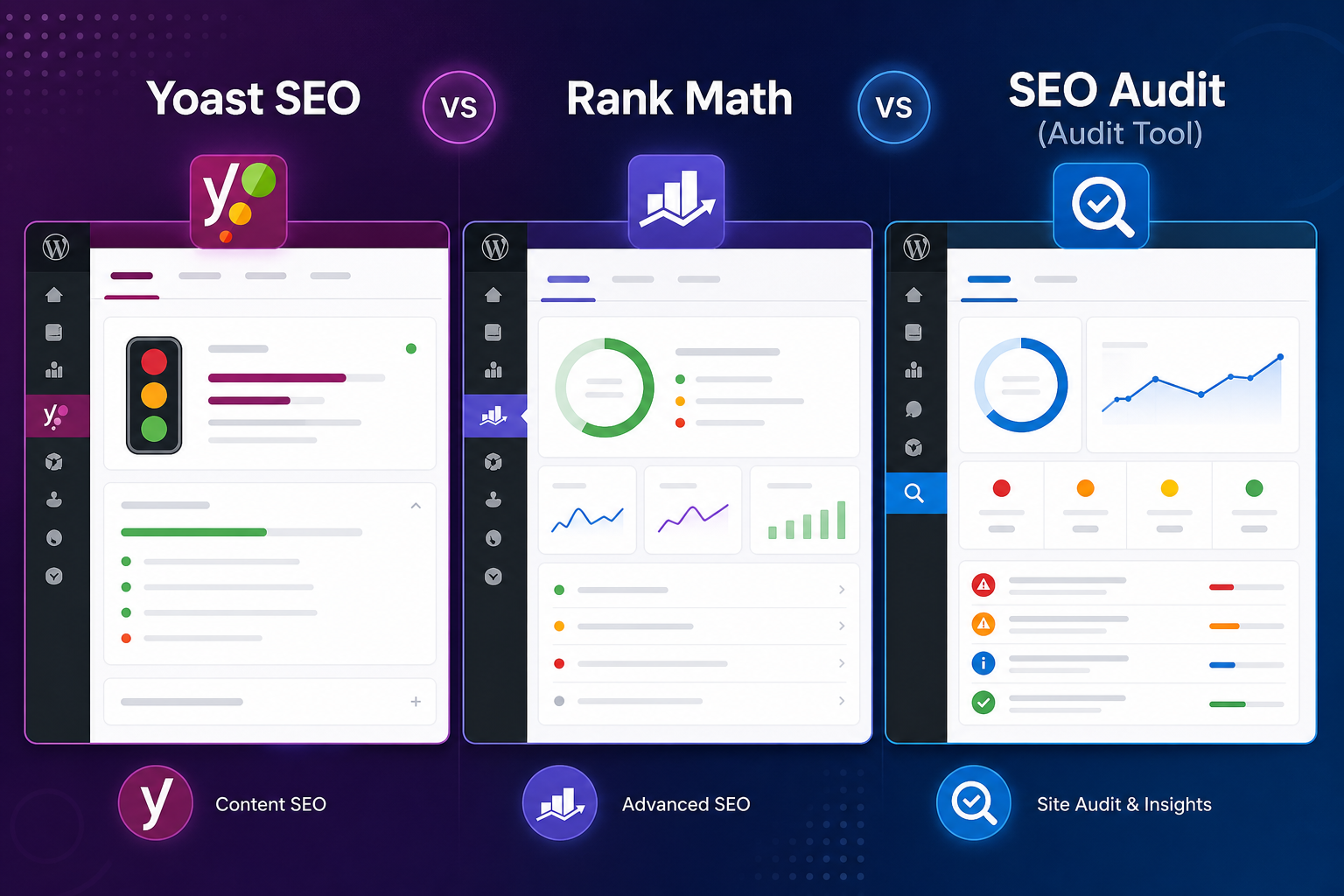
Every WordPress SEO thread eventually asks the same question: Yoast or Rank Math?
Both are good plugins. Both handle titles, meta descriptions, sitemaps, schema basics, and content hints while you write. For a lot of sites, either one is fine — pick one, configure it, move on.
But the question people should ask more often is different: when is a general SEO plugin enough, and when do you need something built for auditing at scale?
That’s where confusion starts. Yoast and Rank Math are editors’ tools first. Citence and MiroPage-style audit tools are diagnostic tools first. Comparing them head-to-head as if they’re the same category leads to wrong expectations and half-fixed sites.
What Yoast and Rank Math Are Built For
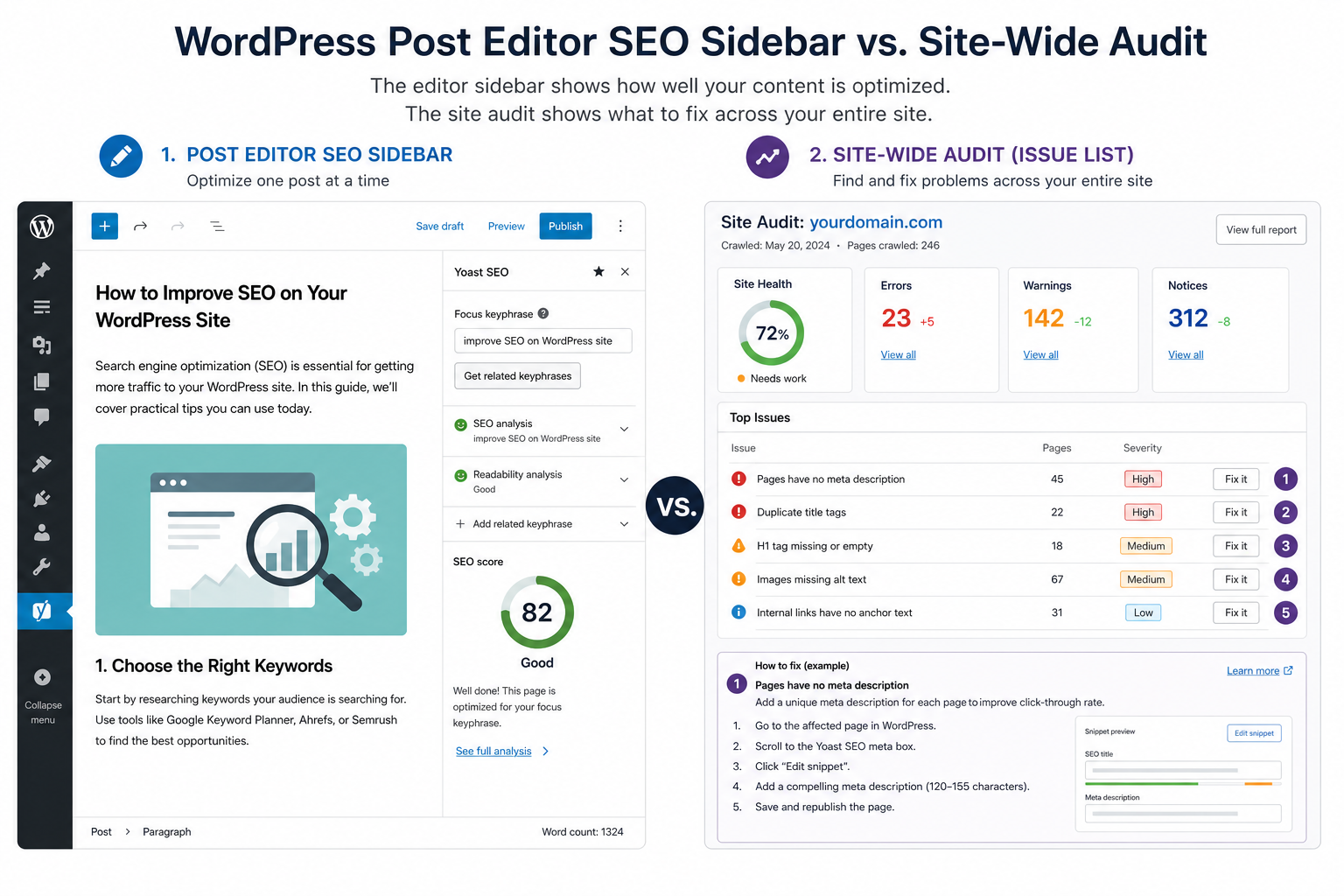
General SEO plugins live in the post editor. They help you set a focus keyphrase, preview the SERP snippet, manage canonical URLs, generate XML sitemaps, and output baseline schema.
Yoast SEO — mature, widely supported, conservative feature set in free tier. Premium adds redirects, internal linking suggestions, and more. Familiar UI. Heavy on content analysis while writing.
Rank Math — aggressive free tier, modular setup wizard, built-in redirects and more schema options in free. Faster feature velocity. Some teams love the dashboard; others find it noisy.
Both answer: “Is this post configured correctly before I publish?”
Neither fully answers: “What’s broken across 800 URLs I published over three years?”
Where General SEO Plugins Stop Short
Site-wide drift
Posts published in 2021 have different title patterns than 2024. Category archives got noindexed by accident. Half your products missing meta descriptions. A plugin update changed schema defaults. General SEO plugins don’t give you a prioritized fix queue across the whole site unless you buy premium modules — and even then coverage varies.
WooCommerce at scale
Product templates, variation URLs, duplicate titles across SKUs, schema conflicts with WooCommerce core — editor-level SEO plugins help per product if you open each one. Nobody opens 2,000 products manually.
AI citation and answer-engine readiness
Traditional focus keyphrase scoring doesn’t measure whether your content is structured for AI answers — clear definitions, quotable paragraphs, entity clarity. That’s a newer problem general plugins weren’t designed for.
Scheduled re-audits
SEO isn’t set-and-forget. Content decays, plugins change, templates break. Ongoing scheduled audits with history — what changed since last month — sit outside what Yoast/Rank Math optimize for.
What Dedicated Audit Tools Add
Tools like Citence and MiroPage SEO focus on diagnosis and fix lists rather than inline writing hints.
MiroPage SEO — strong for pre-publish and per-page audits: titles, meta, headings, content quality signals before something goes live. Good when editorial quality at publish time is the bottleneck.
Citence — broader site audits, WooCommerce product checks in Pro, AI-assisted fixes, tracked prompts for AI visibility, scheduled runs, export/reporting. Good when the site already exists and you need a prioritized backlog.
They complement a general SEO plugin — they don’t replace sitemaps or baseline meta management unless you deliberately consolidate.
Practical Setup Most Stores Should Use
- One general SEO plugin (Yoast or Rank Math — not both) for sitemaps, defaults, editor meta fields
- One audit tool for quarterly site sweeps and WooCommerce/product focus
- Search Console for indexing reality — plugins don’t replace GSC
Running Yoast and Rank Math together is a common mistake — duplicate meta, duplicate schema, conflicting sitemap endpoints. Pick one.
Side-by-Side: What to Expect
| Need | Yoast / Rank Math | Citence / MiroPage |
|---|---|---|
| Sitemap + baseline meta | Yes | Partial / focused on issues |
| In-editor writing hints | Yes | MiroPage yes; Citence different focus |
| Full-site issue queue | Limited | Yes |
| WooCommerce product batch audit | Manual per product | Citence Pro |
| AI citation tracking | No | Citence Pro |
| Scheduled re-scans + history | Minimal | Citence Pro |
This isn’t “which is best” — it’s which job you’re hiring software to do.
When Yoast Alone Is Enough
Small blog, under 100 posts, no WooCommerce, one author, publishing 2–4 posts a month, no legacy migration mess. Configure Yoast or Rank Math, write good content, watch Search Console. Done.
When You Outgrow Editor-Only SEO
- WooCommerce catalog with hundreds+ SKUs
- Multiple authors and inconsistent title/meta patterns
- Site migration or redesign in the last 12 months
- Indexing issues in Search Console you can’t map to specific URLs
- Competing on AI answer visibility, not just blue links
Those are audit problems. See our guides on pages not indexed and internal linking mistakes for two common triggers.
Migration Tips If You’re Switching Yoast ↔ Rank Math
Both offer import wizards. Still: export redirects first, note noindex settings, screenshot schema settings, run a crawl before and after. Schema duplication during transition weeks hurts rich results — disable overlapping product schema on one side.
Switch during a quiet traffic week. Not the day before Black Friday.
Workflow guides: How to run a Citence audit and MiroPage pre-publish checklist.
The takeaway
Rank Math vs Yoast is the wrong debate if your real problem is 600 broken product titles. General SEO plugins manage publishing defaults; dedicated audit tools manage site health at scale.
Use one general plugin for sitemaps and meta fields. Add MiroPage or Citence when you need a fix list, WooCommerce coverage, or ongoing audits. Search Console tells you if Google agrees.